
GST Registration Documents List: Checklist for New Applicants
Applying for GST registration can feel confusing when you are doing it for the first time. The good news is that you do not need a huge file of random papers. The documents depend mainly on your business type, authorised signatory, and business address.
This GST Registration Documents List explains the common documents you may need in simple language, so a beginner can prepare everything before starting the application.
GST Registration Documents List at a Glance
| Document / Information | Usually Needed For |
| PAN | Business / proprietor / entity |
| Aadhaar or applicable identity details | Promoter, partner or authorised signatory, as applicable |
| Photograph | Promoter, partner or authorised signatory, as applicable |
| Proof of business address | Principal place of business |
| Rent/Lease Agreement | Rented or leased premises |
| Consent Letter | Certain premises where consent is required |
| Electricity Bill / Property Tax Receipt | Address proof |
| Authorisation Letter | Authorised signatory, where applicable |
| Partnership Deed | Partnership firm |
| Certificate of Incorporation / relevant constitution document | Company, LLP or other applicable entities |
| Bank details | As applicable after registration |
The GST Portal’s official document checklist includes documents such as property tax receipts, municipal khata copies, electricity bills, rent/lease agreements and consent letters for proof of the principal or additional place of business.
1. PAN Card
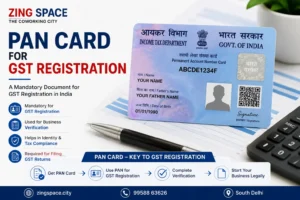
PAN is one of the basic details required for GST registration.
The PAN requirement depends on the type of applicant. For example, a proprietor uses the proprietor’s PAN, while a company or other legal entity uses the applicable entity PAN.
Before applying, make sure the PAN details are correct.
2. Aadhaar and Identity Details
Aadhaar authentication may form part of the GST registration process for applicable applicants.
The GST Portal explains that, depending on the authentication option and taxpayer situation, authentication can involve the Primary Authorised Signatory (PAS) and one promoter/partner.
So, keep the relevant identity information ready before starting the application.
3. Photograph
A photograph may be required for the relevant promoter, partner or authorised signatory, depending on the type of registration.
Keep a clear and recent photograph available in the required digital format.
4. Proof of Principal Place of Business
This is one of the most important sections in the GST Registration Documents List.
You need to establish where your business operates.
Depending on the situation, acceptable supporting documents can include:
| Business Premises | Possible Supporting Document |
| Owned property | Property Tax Receipt |
| Rented property | Rent / Lease Agreement |
| Premises requiring consent | Consent Letter |
| Other applicable premises | Government-issued document |
| Utility-based proof | Electricity Bill |
The official GST document checklist specifically lists property tax receipts, municipal khata copies, electricity bills, rent/lease agreements, consent letters and government-issued documents among the possible proofs for the principal place of business.
5. Rent or Lease Agreement
If your business operates from a rented or leased property, keep the rent or lease agreement ready.
The agreement should clearly support the business address mentioned in the GST application.
Do not upload a random document just because it contains an address. The information should be relevant and readable.
6. Consent Letter
A consent letter can be relevant when the applicant is using premises with the owner’s consent.
For example, if you are using a property but do not have a conventional rent agreement, a consent document may be applicable depending on the circumstances.
The GST Portal’s official checklist includes Consent Letter as one of the documents that may be used for proof of the principal place of business.
7. Documents for Different Business Types
The GST Registration Documents List can change according to your business structure.
| Business Type | Common Documents / Details |
| Proprietorship | Proprietor’s PAN, identity details, address proof and applicable business documents |
| Partnership Firm | Partnership deed, partner details, authorised signatory details and business address proof |
| LLP | LLP/entity documents, partner details and address proof |
| Company | Incorporation/entity documents, director/promoter details, authorised signatory information and address proof |
| Other entities | Documents based on the legal structure and GST requirements |
Do not assume that the document list for a proprietorship will be exactly the same as that for a company or partnership.
8. Authorisation Letter
If someone is acting as the authorised signatory for the business, an authorisation letter may be required in applicable cases.
The GST Portal’s official checklist lists a Letter of Authorisation as proof of appointment of an authorised signatory. For certain entities, a board/management committee resolution and acceptance letter may also apply.
9. Additional Place of Business
If your business has another location, additional documentation may be required for the additional place of business.
The official GST checklist provides similar types of address proofs for an additional place of business, including property tax receipts, municipal khata copies, electricity bills, rent/lease agreements, consent letters and government-issued documents.
What Happens After You Prepare the Documents?
Once your documents are ready, you can proceed with the GST registration application on the GST Portal.
The application process can involve verification and, depending on the case, Aadhaar authentication or other verification requirements.
If the tax officer asks for clarification or additional documents, the GST Portal provides a process for submitting the required clarification and supporting documents.
Conclusion
Having the correct GST Registration Documents List before starting your application can save time and reduce avoidable mistakes. Start with your PAN, identity details, business constitution documents, authorised signatory information, and proof of business address.
The exact documents depend on whether you are registering as a proprietor, partnership, company, LLP, or another type of entity. Therefore, check the latest official GST requirements for your specific situation before submitting the application.
SOURCES
https://google.com/goto?url=CAESmgEB6zswFU_g5aNp-_Yso_HDotEtpzEEDJqWFMYMJchN6skliUAwNtd8AKvNsOiXnb7jhEjBXN6Ic9341pbs0AAItB42tXoq6zhnyfqEp8PtUNAfxxR3Y9SyOtSz-vj8jWn9OQAAn7ecwJ8dq7M1NraHaroAfr5gA1n5HAgPAM6a4tPQNzfOs9B91ZlQxH_9WiqDv7iiD2aITTQ0